
Product Manager Roadmap from PMs at Google, Walmart & Meta

If you want more practical, no-nonsense career tips like these, I share tech, AI and career insights in this newsletter every week. You can subscribe for free :)
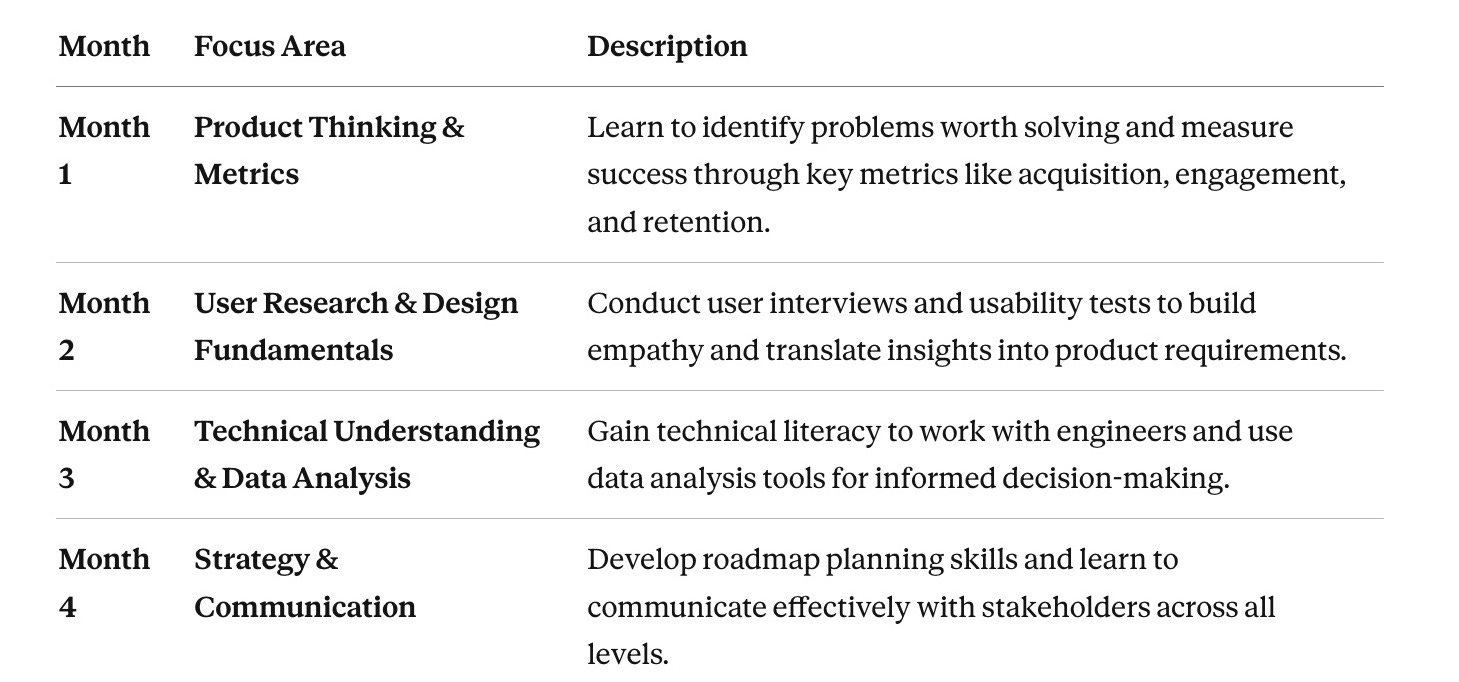
Complete 4 Month Timeline
Real-world Project Example Throughout:
We’ll use Instagram Reels as our running example throughout this article for ease of understanding.
Usecase:
Imagine you’re the PM tasked with improving Reels engagement and creator retention.
Step 1: Master Product Thinking - The Foundation
Product thinking means understanding the “why” behind every feature, connecting user needs to business goals, and making tradeoff decisions with incomplete information.
Real-world Reels Example:
The Problem: Reels engagement has plateaued. Creators are posting less frequently.
Product Thinking in Action:
Why are creators posting less? Is it effort, reach, monetization, or competition?
What trade-offs exist? More algorithmic reach might anger followers who want to see only content from people they follow.
What’s the business impact? Less content = less time spent = lower ad revenue
Who are the users? Casual creators vs. professional influencers have different needs
Free Learning Resources (YouTube)
Product School - Product Management 101- Foundational concepts
Google PM Interview Course by IGotAnOffer - Real frameworks used at big tech
What Product Managers Do with Product Thinking
Identify the root cause of product problems, not just symptoms
Prioritize features based on user impact vs. engineering effort
Make “build vs. don’t build” decisions with data and judgment
Challenge assumptions from engineering, design, and leadership
Define product vision and connect it to company strategy
Step 2: Understand Metrics & Analytics
PMs are obsessed with metrics. Every product decision must be measured. You need to define success metrics, track them, interpret changes, and make decisions based on data.
Real-world Reels Example:
Key Metrics You’d Track:
North Star Metric: Weekly Active Creators (WAC)
Input Metrics:
Creator retention rate (% posting again within 7 days)
Average posts per creator per week
Time spent creating (app usage in creation flow)
Output Metrics:
Total Reels posted per day
Views per Reel
Engagement rate (likes, comments, shares per view)
Analysis Questions:
Did the new editing tools increase post frequency?
Which creator segment churned the most?
Is the 3-month creator retention improving?
Free Learning Resources (YouTube)
Topics to Master
North Star Metrics vs. vanity metrics
Funnel analysis and conversion rates
Cohort analysis and retention curves
A/B testing basics (what PMs need to know)
DAU, MAU, WAU and engagement metrics
Trade-off metrics (improving one might hurt another)
What Product Managers Do with Metrics
Define success metrics for every feature launch
Write A/B test plans and interpret results
Present weekly metrics reviews to leadership
Investigate metric drops and anomalies
Build dashboards for team alignment
Make go/no-go decisions based on data
Step 3: Learn User Research & Empathy
Great PMs are customer-obsessed. You can’t build the right product sitting in a conference room. User research uncovers real problems, validates assumptions, and prevents building features nobody wants.
Real-world Reels Example:
Research Question: Why are creators abandoning Reels mid-creation?
Research Methods You’d Use:
User Interviews: Talk to 15-20 creators who stopped posting
“Walk me through the last time you tried to create a Reel”
“What was frustrating about the editing process?”
Surveys: Send to 1,000 creators who haven’t posted in 30 days
Usability Testing: Watch users try the new editing feature
Data Analysis: Identify drop-off points in creation funnel
Insights Discovered:
Music search is too slow, breaking creative flow
Advanced creators want more editing controls, beginners feel overwhelmed
Free Learning Resources (YouTube)
Judd Antin (Meta) - User Research for PMs - Real Meta examples
Topics to Master
Writing effective interview questions (avoid leading questions)
Running usability tests and moderating sessions
Survey design and avoiding bias
Creating user personas and journey maps
Analyzing qualitative data for patterns
What Product Managers Do with User Research
Write problem statements based on real user pain points
Validate feature ideas before engineering builds them
Present user stories in product reviews
Build empathy across the team through research shareouts
Identify underserved user segments
Step 4: Understand Design Fundamentals
PMs don’t need to be designers, but you need to speak the language. You’ll collaborate daily with designers, review mockups, and make UX decisions that impact millions of users.
Real-world Reels Example:
Design Challenge: Add a “Save Draft” feature without cluttering the UI
Design Thinking You’d Apply:
Information Architecture: Where in the flow should save appear?
User Flow: What happens when someone reopens a draft?
Visual Hierarchy: How do we make it discoverable but not distracting?
Interaction Design: Tap to save? Auto-save? Swipe gesture?
Trade-off Decisions:
Auto-save is easier but uses more storage
Manual save requires user action but gives control
PM Decision: Auto-save for premium users, manual for free (monetization opportunity)
Free Learning Resources (YouTube)
Topics to Master
User flows and wireframing
Basic UI patterns (navigation, forms, feedback)
Accessibility basics (color contrast, screen readers)
Mobile vs. web design considerations
What Product Managers Do with Design
Review mockups and provide product feedback
Collaborate with designers on user flows
Make UX trade-off decisions with design and engineering
Ensure designs align with product goals and metrics
Identofy edge cases designers might miss
Step 5: Build Technical Fluency
PMs don’t code daily, but you need to understand technical constraints, have realistic conversations with engineers, and make informed build decisions.
Real-world Reels Example:
Technical Discussion: Should we add AI-powered auto-captions to Reels?
Technical Understanding You’d Need:
Processing Power: Speech-to-text AI runs on servers (expensive)
Latency: Processing a 60-second Reel takes 5-10 seconds on servers, 30+ seconds on older phones
Storage Costs: Storing caption data for billions of Reels = $2M+ monthly infrastructure cost
Accuracy Issues: AI is 85% accurate, but mistakes in captions frustrate users
Mobile Constraints: Running AI on-device drains 15% battery per Reel created
Engineering Effort: 4 engineers for 3 months to build, test, and optimize
Trade-offs Analysis:
Option A: Server-side processing (fast but expensive, needs internet)
Option B: On-device processing (free but slow, works offline)
Option C: Hybrid (smart but complex to build)
PM Decision: Start with Option A for premium users only (monetization + manages costs). Roll out to all users in 6 months when we optimize costs. Only 40% of creators want this, but it increases accessibility and watch time by 12%.
Free Learning Resources (YouTube)
Topics to Master
How web and mobile apps work (client-server model)
APIs and how systems communicate
Databases basics (SQL vs. NoSQL for PMs)
Cloud services and scalability concepts
Mobile development basics (iOS vs. Android constraints)
Technical debt and why engineers care about it
Security and privacy fundamentals
What Product Managers Do with Technical Knowledge
Write technical requirements that engineers follow
Participate in architecture discussions
Make realistic build vs. buy decisions
Understand engineering effort estimates
Prioritize technical debt vs. features
Communicate technical constraints to non-technical stakeholders
Step 6: Master Strategy & Prioritization
This separates good PMs from great ones. Anyone can write features. Strategic PMs connect daily work to company vision, prioritize ruthlessly, and say “no” to good ideas for great ones.
Real-world Reels Example:
Strategic Challenge: You have 6 months and 3 engineers. What do you build?
Competing Priorities:
Better editing tools (creators want this)
Discovery algorithm improvements (more views)
Monetization features (business wants revenue)
Accessibility features (compliance + inclusion)
Android performance fixes (22% of users affected)
Your Prioritization Framework:
Using RICE (Reach × Impact × Confidence / Effort):
Android fixes: 22% reach × High impact × 90% confidence / 4 weeks = Score: 50
Discovery algorithm: 100% reach × Medium impact × 60% confidence / 12 weeks = Score: 50
Monetization: 30% reach × High impact × 70% confidence / 16 weeks = Score: 13
PM Decision:
Q1: Fix Android (trust issues)
Q2: Discovery algorithm (grows entire product)
Q3: Monetization (after we have more creators)
Free Learning Resources (YouTube)
Topics to Master
Prioritization frameworks (RICE, ICE, Value vs. Effort)
OKRs (Objectives and Key Results)
Product roadmapping (quarterly planning), and weekly sprint planning
Stakeholder management and saying “no” diplomatically
What Product Managers Do with Strategy
Build quarterly roadmaps aligned to company OKRs
Present strategy to leadership and defend priorities
Say “no” to most feature requests
Run prioritization meetings with cross-functional teams
Pivot strategy based on market changes (Eg: Walmart has different strategies for USA, Mexico and Canada markets)
Step 7: Build Your PM Portfolio
If you don’t have PM experience, a portfolio proves you can think like a PM. Projects should show end-to-end product thinking, not just ideas.
Portfolio Structure
Each project should include:
Problem identification (with research/data)
User research (interviews, surveys, or analysis)
Metrics definition (how you’d measure success)
Solution proposal (mockups, specs, or detailed description)
Prioritization rationale (why this vs. other options)
Impact assessment (expected business/user impact)
Types of Projects
1. Improve & Redesign a feature
Choose an existing product and redesign a feature
Example: “Improving Spotify’s Playlist Discovery”
User Research: 15 interviews with users about discovery habits
Problem: 60% of users abandon discovery after 2 playlists (data from usage)
Solution: AI-generated “mood playlists” based on listening history
Metrics: Increase discovery session length by 25%, improve playlist save rate
Mockups: Figma prototype showing new feature
Why this matters: Addresses core user frustration with discoverability
Tools: Figma for mockups, Google Forms for surveys, Notion for documentation
2. Product Teardown
Deep analysis of a product with improvement recommendations
Example: “TikTok Creator Tools: Gap Analysis”
Competitive Analysis: Compare TikTok vs. Instagram vs. YouTube creator tools
User Personas: Casual creators vs. professionals vs. brands
Feature Gap Analysis: What’s missing? What’s better elsewhere?
Strategic Recommendations: Top 3 features TikTok should build next
Prioritization: RICE framework showing why these matter most
Deliverable: 10-slide deck with research, insights, and recommendations
3. New Product/Feature Proposal
Design a product from scratch with full business case
Example: “YouTube ‘Watch Parties’ Feature”
Market Research: Gen Z watches content together on Discord (trend analysis)
User Interviews: 20 interviews on social viewing habits
Product Spec: Detaile
Final Thoughts
If you are looking for job and interview prep resources, follow me on:
LinkedIn (30K+ followers) and
Instagram (122K+ followers)
I hope this helps you :)