
HackOn With Amazon 6.0: Complete Guide

Amazon has officially launched HackOn With Amazon 6.0, one of the biggest student hackathons in India. If you are an engineering student looking for a shot at Rs. 2.25 lakh in prizes, a Pre-Placement Interview (PPI) at Amazon, and mentorship from Amazon engineers, this is the one to focus on right now.
Registration closes on May 28, 2026. Here is everything you need to participate and give yourself the best shot at winning.
What is HackOn With Amazon 6.0?
It is Amazon’s national-level hackathon for engineering and MCA students. The idea is simple: you form a team, crack a coding round, build a working prototype in 48 hours, present it to Amazon’s engineers and leaders, and compete for cash prizes and a direct path to interviews at Amazon.
Who Can Apply?
Here is the eligibility checklist:
Pursuing B.Tech, M.Tech, MCA, or an Integrated Dual Degree at an Indian university
Graduating in 2027 or 2028 batch
Minimum CGPA of 6.5
Eligible branches: CSE, IT, AI, Data Science, Cyber Security, ECE, Electrical, and other circuital branches
Team size: 2 to 3 members
Every team member must individually clear the coding challenge (Round 1) to proceed
What Do You Get?
Cash prizes:
Winner: Rs. 1,00,000
1st Runner-up Rs. 75,000
2nd Runner-up Rs. 50,000
Special category prizes:
Top 75 Coders (from the coding round): Amazon prizes
Top 50 Female Coders: Amazon prizes
Top 25 Fastest Coders: Amazon prizes
Pre-Placement Interview (PPI): Top performers from the hackathon get a direct interview opportunity at Amazon. This is not guaranteed for everyone, but it is a real path to an Amazon offer without going through the standard application cycle.
Mentorship: Shortlisted teams get access to Amazon engineers during the mentorship round (June 29 to July 3).
Certificate: All participants who complete the hackathon receive a certificate.
How to Apply
Step 1: Go to unstop.com/hackathons/crp-hackon-with-amazon-60-amazon-1682652
Step 2: Create or log in to your Unstop account.
Step 3: Register your team (2 to 3 members). All members must register individually and be part of the same team on Unstop.
Step 4: Submit before May 28, 2026.
The Full Timeline
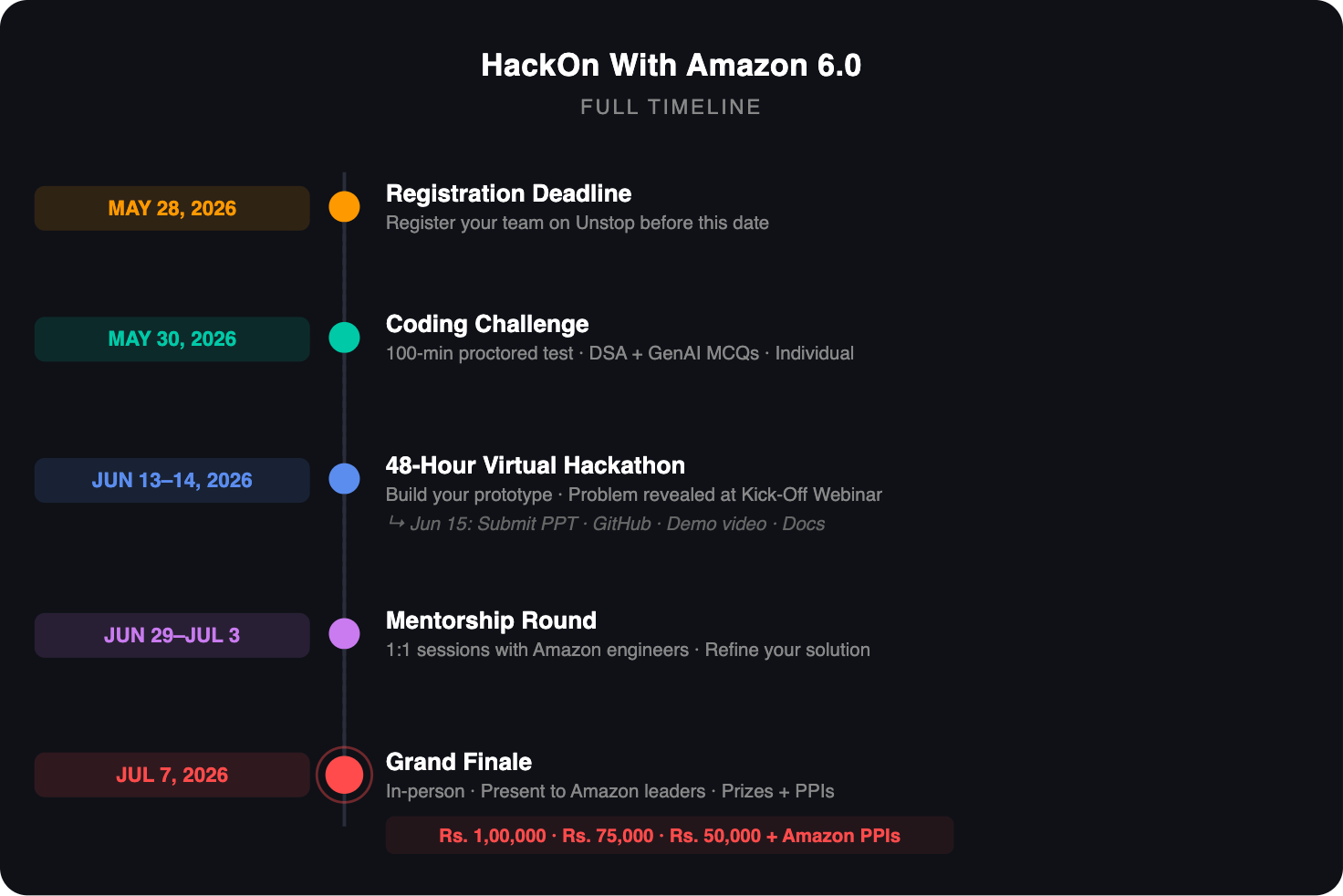
How the Competition Works
Round 1: Coding Challenge (May 30)
Each team member takes this individually. It is a 100-minute proctored test with DSA (Data Structures and Algorithms) problems and GenAI MCQs. Every member must clear this round for the team to advance. If even one member does not clear it, the team is out.
Treat this round seriously. It is the biggest filter.
Round 2: 48-Hour Virtual Hackathon (June 13-14)
Shortlisted teams get access to the problem statement at a Kick-Off Webinar. You then have 48 hours to build a working prototype. This is where the real work happens. You need a functional product, not just a concept.
Round 3: Prototype Submission (June 15)
You submit a package that includes your working prototype, a PPT presentation, a GitHub repository, a demo video, and documentation. Everything needs to be clean, complete, and easy to evaluate. Judges look at this before the mentorship round.
Round 4: Mentorship Round (June 29 - July 3)
Selected teams get dedicated time with Amazon engineers to refine their solutions. Use this round to fix gaps, polish the product, and sharpen your presentation. Teams that make it here are already in a strong position.
Round 5: Grand Finale (July 7, in-person)
Top teams present their solutions to Amazon leaders. This is where prizes and PPIs are decided.
How to Win
Crack Round 1 as a team, not just individually. The most common reason teams get eliminated early is one member not clearing the coding challenge. Practice together. If someone in your team is weak on DSA or GenAI concepts, address it before May 30. You cannot carry a teammate through Round 1.
Build something that solves a real problem at scale. Amazon thinks in terms of scale. A product that works for 100 users is fine, but a product designed to work for 10 million users is what impresses Amazon engineers. Think about your architecture from the start, not as an afterthought.
Use AWS services where it makes sense. Amazon loves to see its own tools used well. S3, Lambda, DynamoDB, SageMaker, Bedrock, and API Gateway are all fair game. You do not need to use all of them, but grounding your solution in the AWS ecosystem shows you understand production-grade engineering.
Incorporate GenAI thoughtfully. Given that Round 1 includes GenAI MCQs and the hackathon focus is on AI engineering, a strong solution will use AI in a way that genuinely improves the product. Using an LLM just to add a chatbot is not enough. Show that the AI is core to the value your product delivers.
Prioritise a working demo over a complete feature set. A prototype with three features that all work is better than a prototype with ten features where half are broken. Judges need to see it running. Every broken feature during a demo costs you more than a missing feature would.
Your submission package is part of your product. A messy GitHub repo, a vague README, and a PPT with 20 text-heavy slides will hurt you even if your prototype is strong. Clean code, a well-documented README, a sharp demo video (under 3 minutes), and a crisp presentation are not optional extras.
Use the mentorship round as a rehearsal. When you get Amazon engineers in the room during the mentorship round, ask them what gaps they see. Then fix those gaps before the finale. Teams that treat mentorship as validation (”we just want to confirm we are on the right track”) do not improve as much as teams that treat it as critical feedback.
Project Ideas to Build
Amazon has not released official problem statements yet. Those come at the Kick-Off Webinar. But HackOn historically focuses on real-world tech challenges, and the emphasis on AI Engineering and scalability gives you a strong hint of the direction.
Here are project ideas in that space that would align well with Amazon’s engineering culture:
AI-powered seller tools for e-commerce. Build a tool that helps small sellers on Amazon optimise their listings, predict demand, or manage inventory using AI. This directly solves a real problem at Amazon’s scale.
Smart customer support automation. Build a system that classifies customer complaints, auto-resolves common ones, and escalates edge cases to humans, all with an LLM at the core. Focus on accuracy and latency.
Delivery route optimisation using ML. Build a model that predicts optimal delivery routes based on traffic, weather, and order priority. This is a classic Amazon logistics problem that plays well in hackathons.
Fraud detection for marketplace transactions. Build a real-time system that flags suspicious seller or buyer behaviour. Use anomaly detection or classification models. Show that it scales.
Personalised product recommendation engine. Build a lightweight recommendation system that learns user preferences from browsing and purchase history. Focus on cold-start handling (what to show new users with no history).
Document intelligence tool. Build a tool that extracts structured data from unstructured documents (invoices, receipts, contracts) using AI. Amazon processes enormous volumes of documents internally.
Supply chain disruption predictor. Use historical data and external signals (weather, news, shipping data) to predict supply chain bottlenecks before they happen.
Pick an idea that your team can actually build in 48 hours. A simpler idea executed well beats an ambitious idea with a broken demo every time.
What Your Submission Must Include
This section is specifically about what judges will evaluate in Round 3:
GitHub repository: Clean folder structure, a README that explains what the project does, how to run it, and what problem it solves. Include tech stack, architecture, and any setup instructions. Judges check this.
Demo video (under 3 minutes): Show the product running end-to-end. Do not show slides. Do not narrate architecture diagrams. Show the actual product doing the actual thing it is supposed to do. Keep it tight.
PPT presentation: Eight to twelve slides maximum. Cover the problem, your solution, the tech stack, architecture, how it scales, and results or impact metrics. Put numbers wherever you can. Judges read dozens of decks. Yours needs to be scannable.
Documentation: A short document explaining your approach, what you built, what you tried that did not work, and what you would do with more time. This signals engineering maturity.
Working prototype: It does not need to be pretty. It needs to work. Have a fallback plan (screenshots or a pre-recorded video of it working) in case something breaks on the day.
How to Prepare for Round 1 Right Now
You have until May 30. That is less than a week. Here is how to use it.
DSA topics to focus on: Arrays, strings, graphs, dynamic programming, trees, and sliding window problems. HackOn’s coding rounds are typically medium to hard difficulty on LeetCode. Practice on LeetCode, Codeforces, or GeeksforGeeks.
GenAI MCQ preparation: Understand the basics of how large language models work, what prompt engineering is, what RAG (Retrieval-Augmented Generation) means, and common GenAI use cases. Amazon Bedrock documentation is a good resource here.
Practice on a timer. The round is 100 minutes. Solving problems without a clock is very different from solving them under one. Run at least two timed mock sessions before May 30.
Do not skip the GenAI MCQs. Many students focus only on DSA and underestimate the MCQ section. It is scored too. A strong performance on MCQs can offset a slower performance on coding questions.
Final Thoughts
HackOn With Amazon 6.0 is one of the few student competitions where the outcome can directly change your career trajectory. A PPI at Amazon is not a small thing. Even if you do not win, the mentorship round and the experience of building something under pressure in 48 hours is worth the effort.
The registration deadline is May 28. If you have a team, register today.
If you are looking for more such tech, AI, and career resources, follow me on:
Instagram (240K+ followers)
LinkedIn (35K+ followers)
I hope this helps you :)